Osteoporosis
Contents
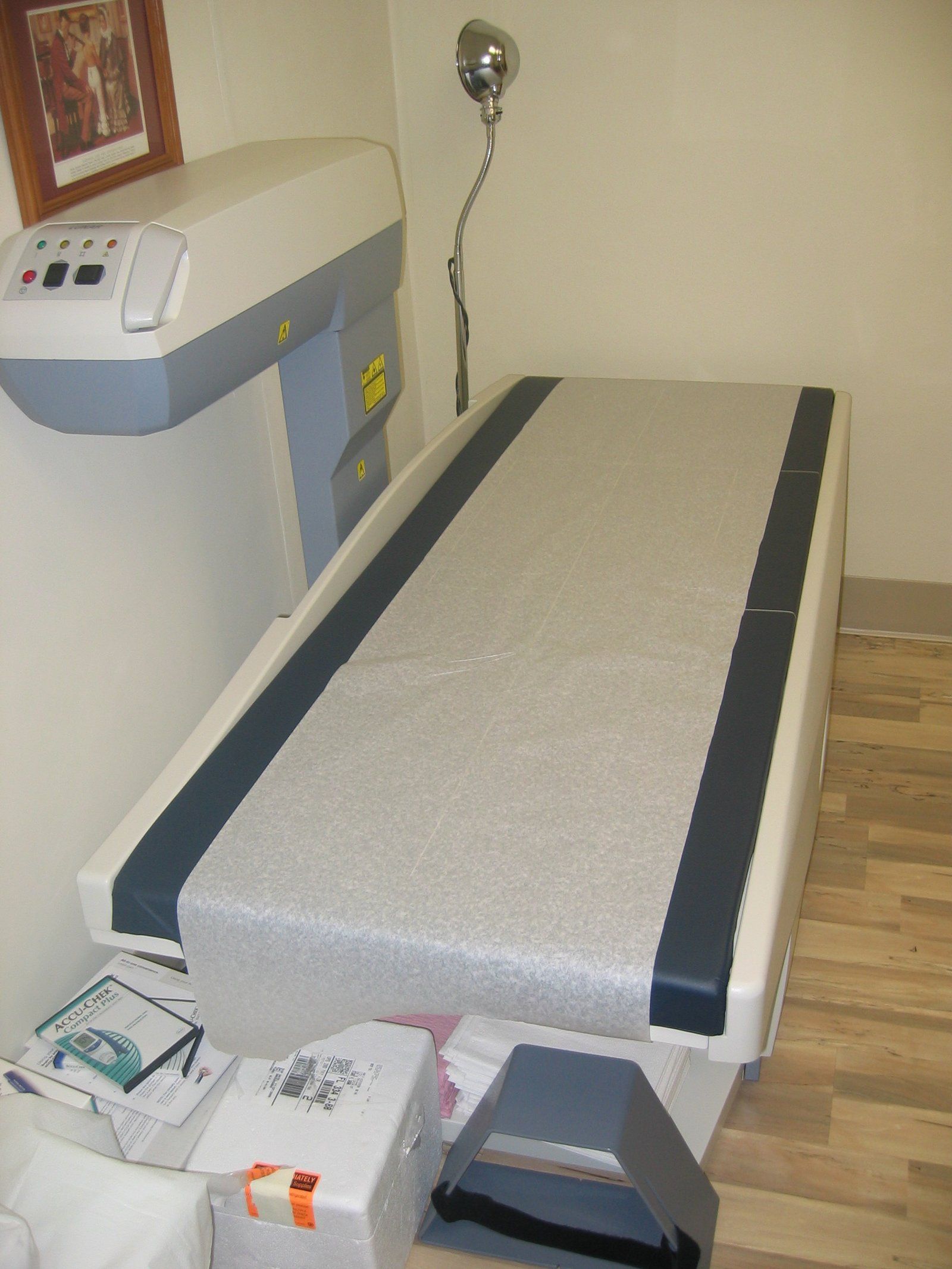
Candace Cooley has performed and interpreted DEXA bone density scans, which are aimed at the two places where osteoporosis typically shows itself, the hip and the lower spine. Osteoporosis is a loss of bone strength that usually gives no warning until one of those places, or the wrist, breaks. The National Institute on Aging calls it a silent disease for that reason: most people notice no change at all until a bone fractures.4
The inside of a bone
Bone looks solid from the outside, but its interior is closer to a sponge. The National Institute on Aging compares it to a honeycomb and explains that in osteoporosis the bony walls of that honeycomb shrink, the spaces between them widen and the outer shell grows thinner, so the whole structure weakens. In serious cases, the institute notes, a cough or a minor bump is enough to cause a fracture.4 The National Institute of Arthritis and Musculoskeletal and Skin Diseases defines the disease broadly, as a fall in bone mineral density and mass, or a change in the quality and structure of bone, that reduces its strength, and lists the hip, the vertebrae and the wrist as the commonest sites of fracture.5
How osteoporosis weakens a bone
- RemodelingThe body breaks down old bone and replaces it with new bone throughout life.
- ImbalanceOsteoporosis develops when more bone is broken down than is replaced.
- ThinningThe inner honeycomb walls shrink, the spaces widen and the outer shell thins.
- FractureA minor bump or fall, or in serious cases a cough, can break the weakened bone.
How bone is kept and lost
Bone is living tissue that is rebuilt all through adult life. The same NIH institute states that almost all of the adult skeleton is remodeled every 10 years, old bone broken down and new bone formed in its place, and that mass is lost when breakdown outpaces formation.5 The machinery behind that balance has become clearer in recent years. A MedPage Today review describes breakdown and rebuilding as processes that run at the same time inside a small working unit of bone cells rather than one after the other, and names the signals that steer them: RANKL, which switches on the cells that resorb bone; osteoprotegerin, a decoy that blocks it; and sclerostin, made by bone cells themselves, which slows formation.9
Estrogen sits inside that system. A 2023 review in PubMed Central explains that estrogen restrains resorption through the RANKL pathway and lowers the number of resorbing cells, so its loss at menopause tips the balance toward net loss. The same review observes that over roughly three decades osteoporosis went from being seen as a normal part of aging to being recognized as a chronic illness with defined diagnostic criteria.7
Who develops it
The National Institute on Aging puts the figures at about one in five women over 50 and one in 20 men. Its list of risks includes a family history of fractures, a broken bone after 50, surgery that removes both ovaries before periods have stopped on their own, too little calcium, vitamin D or protein, inactivity, smoking, certain long term medications, hormone changes and low body weight.4 The Bone Health and Osteoporosis Foundation adds that of an estimated 10 million Americans with the disease, about eight in ten are women, and gives two reasons: women’s bones tend to be smaller and thinner, and the estrogen that protects bone falls sharply at menopause.6 Inheritance matters as well. In the MedPage Today review, a bone specialist estimates that bone mass is about 70 percent genetically determined, while noting that no single gene governs the risk the way some genes govern certain cancers.9
Osteoporosis after age 50, percent affected
Men are not exempt
Because osteoporosis is so often treated as a women’s disease, men are tested less. KFF Health News reports that about one in five men over 50 will have an osteoporotic fracture, and that men who break a hip recover less well than women, with death rates of 25 to 30 percent within a year. The report adds that men tend to develop the disease five to 10 years later than women, since their bones start larger and thicker.2 NIAMS makes the matching point that men reach a higher peak bone mass and lose it more slowly, in part because they do not go through the estrogen drop of menopause.5
How it is found
Because the disease is quiet, it is usually found by measurement or by a fracture. The National Institute on Aging describes the bone density scan as a comparison of a person’s bones with those of an average healthy young adult, reported as a T score that separates osteoporosis from osteopenia, the milder loss.4 The scan itself, dual energy X ray absorptiometry, has its own entry, as do the rules for who is tested and when. Those rules have shifted over time: NBC News reported in 2011 that the U.S. Preventive Services Task Force widened its advice so that women 65 and older, and younger women past menopause at high risk, should all be screened.1
What a fracture costs
The burden of the disease arrives with the break, and the break often comes from very little force. The National Institute on Aging points out that people with osteoporosis also recover from fractures with more difficulty, sometimes with pain that does not go away, and that broken hips and spines can cost older adults their mobility and independence.4 The Bone Health and Osteoporosis Foundation states that roughly one in two women over 50 will break a bone because of osteoporosis, and that a woman’s risk of hip fracture equals her combined risk of breast, uterine and ovarian cancer.6 In the MedPage Today review, a specialist describes a broken hip as fatal a quarter of the time and disabling half the time, and argues that fewer than half of the people eligible for screening receive it. The same review lists the earlier clues that sometimes come before a first fracture: unexplained back pain from a weakened vertebra, a measurable loss of height, and a stooped posture that can signal a compression fracture in the spine.9 KFF Health News describes the same pattern in men, who often learn of the disease only after a fall that should not have broken anything.2
Osteoporosis in the United States
- Americans estimated to have osteoporosis
- 10 million
- of them women
- 80%
- women over 50 who will break a bone because of it
- 1 in 2
Prevention and treatment
Treatment aims to slow or stop bone loss before a bone breaks. The National Institute on Aging describes regular exercise and a sound diet as the base, with medicines added when density is low or other risks are present; some medicines, including bisphosphonates and estrogen, slow loss, while others help rebuild bone.4 Exercise works on the skeleton directly. The Associated Press reports a physical therapist’s explanation that muscle pulling on bone during resistance work stimulates bone building cells, and notes that bone mass peaks between 25 and 30 and starts to decline slowly around 40.3 CNN adds that working muscles release a hormone called irisin that stimulates those same cells.8 NBC News quoted the task force chair’s warning that once osteoporosis is established new bone is hard to build, which is why the emphasis falls on finding it early.1 Which of these steps suits a particular woman is a question for her own clinician, who can weigh her history and results.
A short glossary
- Bone mineral density: the amount of mineral in a given area of bone, the quantity a bone scan measures.4
- Osteopenia: low bone density that is not as severe as osteoporosis.4
- Remodeling: the lifelong breakdown of old bone and its replacement with new bone.5
- RANKL: the signal that activates the cells that resorb bone; estrogen damps it.7
- Osteoprotegerin: a decoy molecule that binds RANKL and slows bone turnover; estradiol raises its production.9
- T score: the comparison of a measured bone density with that of a healthy young adult, the figure used to name osteopenia or osteoporosis.4
- Sclerostin: a protein made by bone cells that holds back bone formation.9
- Peak bone mass: the most bone a person will have, reached in early adulthood.3
References
- NBC News. Women under 65 need osteoporosis screening, 2011 01 18.
- KFF Health News. Why Brittle Bones Aren't Just a Woman's Problem, 2025 10 14.
- AP via NBC Washington. Strength training is crucial after menopause. How to make the most of your workouts, 2026 01 10.
- National Institute on Aging. Osteoporosis, 2017 05 17.
- NIH. Osteoporosis in Men, 2023 05 05.
- Bone Health and Osteoporosis Foundation. What Women Need to Know, 2025 09 16.
- PubMed Central. Role of menopausal hormone therapy in the prevention of postmenopausal osteoporosis, 2023 12 12.
- CNN. Concerned about osteoporosis? What helps prevent fractures beyond medication, 2026 04 02.
- MedPage Today. New Insights Into the Complex Biology of Osteoporosis.
External links
See also
-
 Bone Health
Dual Energy X Ray Absorptiometry
The low dose X ray test behind nearly every bone density number, explained from the table to the report.
- Bone Health
Osteoporosis Screening
The rules that decide which bones get measured, and how they moved from an age line toward a reading of risk.
- Bone Health
T Scores and Z Scores
Two numbers on every bone scan report, each measured against a different reference group.
- Bone Health
Bone and the Menopause Transition
A lifetime of bone has a turning point, and it arrives with the final years of menstrual cycles.
- Menopause and Midlife
Perimenopause
The stages researchers use, the age it tends to start, and why no single blood test settles it.