Bone and the Menopause Transition
Contents
The bone density evaluations that Candace Cooley has carried out and read with DEXA technology are snapshots taken along a timeline that spans decades of adult life. A typical course runs like this. The Associated Press reports that bone reaches its greatest mass in the late twenties and starts to fall off gently at about age 40.1 Estimates of the peak differ; a review in Contemporary OB/GYN places it at around 35, with bone gained well into the fourth decade.8 Then the pace changes. An orthopedic surgeon told CBS News that the gradual decline accelerates about two years before menopause, and that roughly 10 percent of density can be lost in that narrow window.7 After several years of rapid loss, the National Institute on Aging explains, the decline slows but continues, and by 65 or 70 women and men lose bone at the same rate.2
Where the transition sits
Menopause is a single point in time, defined after the fact. A National Institute on Aging research summary places it 12 months after a woman’s last period, and calls the years leading up to it the menopausal transition, or perimenopause, which usually begins between 45 and 55 and lasts about seven years. Hormone levels swing widely during that stretch, which is why symptoms such as hot flashes and poor sleep come and go.3 A 2023 review in PubMed Central gives a perimenopausal span of four to eight years, marked by hormonal and clinical changes. As the ovarian reserve runs down, the review explains, cycles grow shorter or irregular, the pituitary hormones FSH and LH rise in the blood, and estradiol, unlike the slower falling androgens, drops quickly once menopause has passed.4
A typical course of bone across adult life
- BuildingAbout 90 percent of bone density is gathered by the thirties, when bones are strongest.
- Gradual declineA slow loss follows through the middle years.
- AccelerationRoughly two years before menopause the loss speeds up.
- The windowAbout 10 percent of density can be lost in that narrow stretch of time.
Why estrogen matters to bone
Bone is rebuilt constantly, and estrogen is one of the brakes on the breakdown side. The PubMed Central review explains that estrogen acts through the RANKL signaling pathway to reduce the number and activity of bone resorbing cells, and that its absence during menopause raises resorption while formation stays roughly constant, a mismatch first described as uncoupling. The result is net loss, with thinning and breakage of the fine internal struts of bone. The idea is not new: the review credits the endocrinologist Fuller Albright with first linking estrogen insufficiency at menopause to poor bone health.4 The Bone Health and Osteoporosis Foundation puts it in plain terms: estrogen protects bone, and it falls sharply at menopause.5
How fast the loss runs
The foundation states that a woman can lose up to 20 percent of her bone density in the five to seven years after menopause, and names two factors that decide whether she reaches osteoporosis: how much bone she has when menopause arrives, and how quickly she loses it afterward.5 The Contemporary OB/GYN review adds that after the transition the rate slows to an average of about half a percent a year, and that the number of years since a woman’s final period predicts her bone density better than her age does.8 The same review estimates that age and menopause together reduce density by about 30 percent by age 80. Estrogen loss affects muscle too; the Associated Press notes that it contributes to a gradual loss of muscle mass in the same years.1
Bone and women, in figures
- of bone density lost in the five to seven years after menopause
- Up to 20%
- share of Americans with osteoporosis who are women
- 80%
- women over 50 who will break a bone because of osteoporosis
- 1 in 2
Fractures that follow
The loss shows up in fractures on a delay. The PubMed Central review notes that wrist fractures become more common around the time of menopause, while hip and spinal fractures rise later, at older ages, and it recommends a full risk assessment for a recently menopausal woman who breaks a wrist.4 The National Institute on Aging lists surgical removal of the ovaries, ahead of a natural menopause, among the risk factors for osteoporosis, a reminder that it is the drop in estrogen, not age alone, that drives the change.2 The scan used to track density through these years has its own entry, on DEXA scanning.
What the large studies showed
Much of what is known comes from long studies of women in midlife. MedlinePlus Magazine recounts that the Women’s Health Initiative, launched in 1991 with more than 161,000 women, set out to prevent heart disease, certain cancers and osteoporosis after menopause, and that its 2002 findings on combined hormone therapy led to a steep drop in hormone use. A second federal project, the Study of Women’s Health Across the Nation, began in 1994 with younger and more diverse participants.6 According to the National Institute on Aging summary, its annual visits with more than three thousand women, recruited in their forties and early fifties, have let researchers tell the effects of growing older apart from the effects of the ovaries winding down, a distinction that matters for bone as much as for the heart.3 The PubMed Central review reports that in the same trial combined therapy reduced hip fractures by 34 percent over about five years.4 The National Institute on Aging summary describes a later trial, in women whose final period had come no more than three years earlier, in which both hormone forms tested helped maintain bone density, and notes that the U.S. Preventive Services Task Force still does not recommend hormone therapy to prevent chronic disease.3
The honest limit
The timeline above is an average, and averages say little about any one woman. The foundation notes that bone loss after menopause is rapid and severe for some women and slower for others.5 The PubMed Central review finds limited evidence that the skeletal benefit of hormone therapy lasts once treatment stops.4 And the National Institute on Aging describes a long running study of women followed from midlife that is only now asking how the transition shapes musculoskeletal health in early old age.3 Where a particular woman sits on the timeline, and what to do about it, is a matter for her and her own clinician. The disease the loss can lead to is described under osteoporosis.
References
- AP via NBC Washington. Strength training is crucial after menopause. How to make the most of your workouts, 2026 01 10.
- National Institute on Aging. Osteoporosis, 2017 05 17.
- National Institute on Aging. Research explores the impact of menopause on women's health and aging, 2022 05 03.
- PubMed Central. Role of menopausal hormone therapy in the prevention of postmenopausal osteoporosis, 2023 12 12.
- Bone Health and Osteoporosis Foundation. What Women Need to Know, 2025 09 16.
- NIH MedlinePlus Magazine. What we know, and still don't know, about menopause, 2023 09 12.
- CBS News. Bone density and the silent disease: 4 things women should know about bone health, 2026 09 23.
- Contemporary OB/GYN. Postmenopausal osteoporosis, 2023 05 08.
External links
See also
- Bone Health
Osteoporosis
The quiet thinning of the skeleton, from the honeycomb inside a bone to the fracture that reveals it.
-
 Bone Health
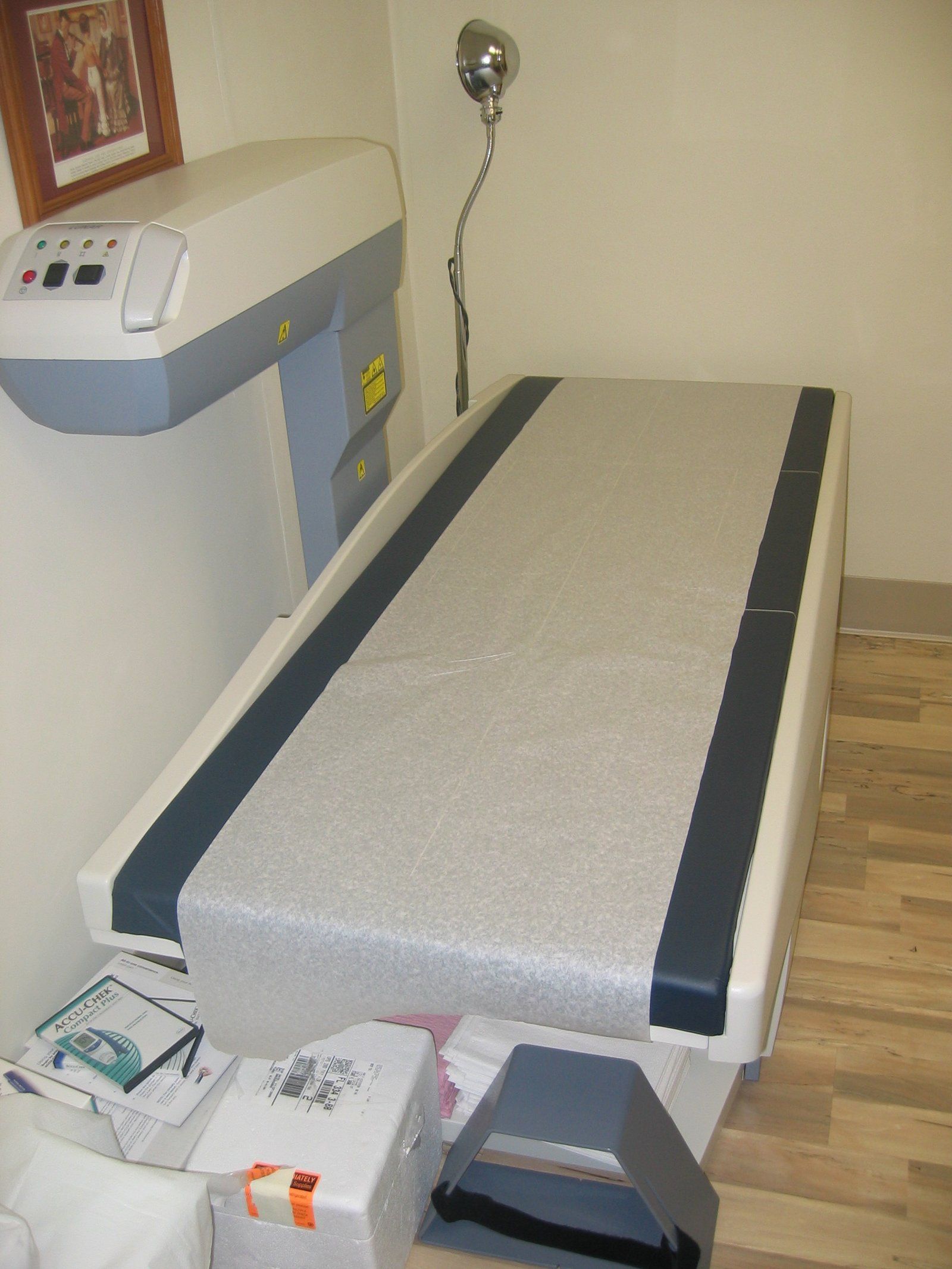
Dual Energy X Ray Absorptiometry
The low dose X ray test behind nearly every bone density number, explained from the table to the report.
- Bone Health
Osteoporosis Screening
The rules that decide which bones get measured, and how they moved from an age line toward a reading of risk.
- Bone Health
T Scores and Z Scores
Two numbers on every bone scan report, each measured against a different reference group.
- Menopause and Midlife
Perimenopause
The stages researchers use, the age it tends to start, and why no single blood test settles it.